VAULT / NOTE
What is Technology
Defining technology is harder than it seems. The word gets used to mean everything from the smartphone in your pocket to "the direction society is heading," and that ambiguity lets people argue past each other endlessly. I think everyone with a strong opinion about technology being good or evil should have to say where they draw their line.
The spectrum problem
Is a smartphone evil? A laptop? A desktop? An LCD screen? A transistor? Boolean logic? The printing press? The clock? The plow? The axe? Fire?
Zero technology is "vanilla earth" — a human with only bare hands, unable to hold anything, build anything, throw anything. Essentially an animal without thumbs. But even animals have technology: a bird's nest, an ant hill, primates that use sticks to extract termites. The line between "natural" and "technological" is already blurry before humans enter the picture.
Tools vs. systems
Neil Postman makes a useful distinction. A hammer is a tool — it does what you make it do, has no ideology, extends your arm. Television is a technology-as-system — it restructures social life, changes what we think is worth knowing, reshapes what counts as public vs. private. The tool is neutral; the system has tendencies.
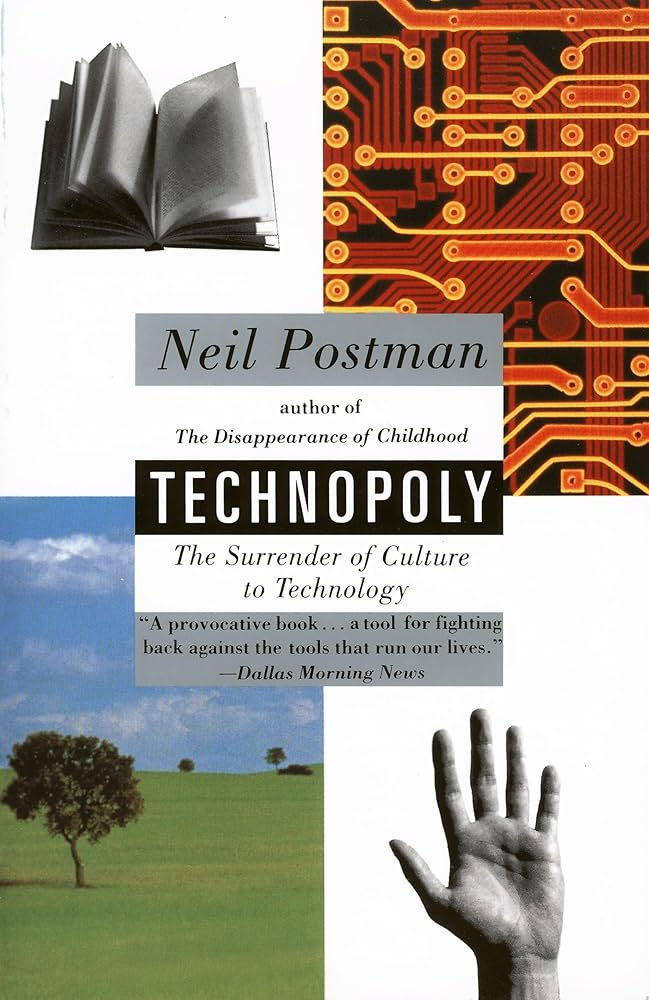
The danger isn't the tool. It's when a technology becomes a total environment — what Postman called a Technopoly: a culture that has surrendered to technology, where efficiency is the primary value and data is the primary arbiter of truth. In a Technopoly, anything that can't be measured doesn't count.
The question worth asking
Not "is this technology good or evil?" but: what does this technology make easier, and what does it make harder to notice?
Every tool optimizes for something and trades something off. The printing press democratized information and made mass propaganda possible at the same scale. The clock made coordination possible and made it possible to be late. The calculator makes arithmetic effortless and makes it easy to lose your intuition for whether an answer is plausible.
Technology doesn't have values, but it has tendencies. The work is staying conscious of them — especially once a technology becomes infrastructure and starts to feel like the natural order of things.
References
Technopoly — Neil Postman